

























 EBOOK
EBOOK Insights
 Blog
Blog Tutorials
 GRASS FED
 training
 LIVES
LIVESCOLLAGEN WHY IS IT GOOD FOR US?
HOW WE ARE MADE
The human body is composed of:
- 62% water
- 16% fat (varies between men and women)
- 16% proteins
- 6% minerals
- 1% carbohydrates
WHAT ARE PROTEINS
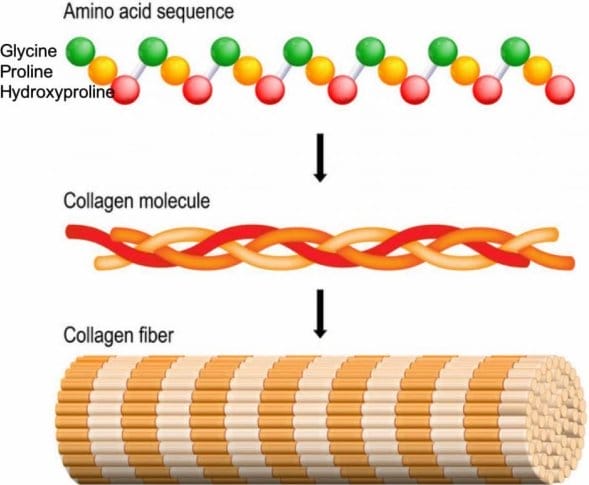
Proteins are macromolecules made up of chains of amino acids. Imagine them as a pearl necklace, where the pearls are precisely the different amino acids.

There are 20 amino acids in our body, 9 of which are essential i.e., which it is necessary to take in with food. As for the other 11 amino acids, the body if it needs them produces them by itself.
COLLAGEN
Collagen is the most abundant protein in the human body (30%) and is found mainly in the skin, but also in muscles, tendons, blood vessels, cartilage, teeth, bones, and corneas.
It is as if collagen is a “glue” that supports the cells that make up these tissues. Just think that when water is removed, 80% of the skin's weight is collagen!
There are at least 29 types of collagen in the human body, but 90% is type I collagen. All types of collagen are made up of 19 amino acids, but there is a predominance of 3 amino acids: glycine, proline, and hydroxyproline.
Now the reasoning is very simple:
- Collagen is the main protein in our body
- To synthesize collagen, our body needs certain amino acids
- if I provide him with exactly those amino acids, I make his life easier (remember that nature does not like to struggle: if you observe it, you will notice that it always looks for the easiest way because it saves energy that way)
Since collagen is mainly made up of glycine, proline and hydroxyproline, how can I supply just these amino acids to my body? By eating collagen!
Collagen exists only in the animal world. There is no collagen of plant origin.
SOURCES OF COLLAGEN
Today our diet is low in collagen as we no longer eat the foods that contain it in abundance: pork rinds (by far the richest food in collagen), pig feet and ears, chicken feet and skin, ribs, tail, etc.
COLLAGEN PRODUCTION
Collagen is produced from procollagen, which is synthesized by the body by combining glycine and proline. This process uses vitamin C so it is good that our diet is rich in it.
Another important mineral necessary for collagen production is copper, of which cocoa powder is an excellent source! Also important is zinc, which we also find in cocoa powder.
Finally, the body also needs other amino acids to produce collagen-the best sources are meat, fish, and eggs, which are referred to as “noble proteins” because they contain all the amino acids esseziali in the necessary proportions.
BENEFITS
In recent years, collagen has been the focus of numerous scientific studies noting these possible benefits:
- reduces wrinkles
- increases skin elasticity
- reduces cellulite
- promotes the growth of healthy nails
- decreases joint pain
- Mitigates bone loss and improves bone density
- increases muscle mass
- helps fight atherosclerosis
GLYCINE
Definitely all very interesting benefits, however, my passion for collagen stems from the fact that it is the absolute richest food in the amino acid glycine. Why is this important? Because it seems that the amount of glycine we consume in our diet determines the amount of glutathione our body will be able to produce. Glutathione is one of the most powerful antioxidants in our bodies (13) and fighting oxidation is fonamental to our health.
Other possible benefits related to glycine:
- protects the cardiovascular system
- controls inflammation
- improves sleep
- protects the liver
- controls metabolic syndrome
- Counteracts protein glycation
- controls diabetes
And then there is something super interesting: a 2015 Japanese study published in Nature (14) where it was observed that providing glycine to the mitochondria of cells of older people corrected defects caused by aging and practically rejuvenated them! This was an in vitro study (done in test tubes on tissue samples), so there is a big difference from studies done in-vivo (i.e., on living beings). However, I find the results of this study fascinating and it was the beginning of my great love for collagen!
IMPORTANT
I want to emphasize that none of these benefits are certain. The only health claims that are proven and officially recognized are those published on the EFSA website.
WHAT DAMAGES COLLAGEN
- Sugars (carbohydrates): cause glycation of collagen fibrils, preventing their repair
- Pollution
- Excessive exposure to the sun
- Tobacco
- Alcohol
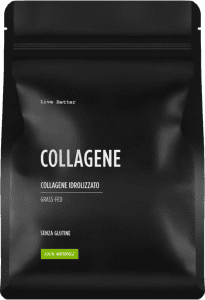
OUR COLLAGEN
Our collagen comes from cattle raised on pasture throughout their lives.
I contacted all the collagen producers I could find, and no one guarantees that the animals are fed pasture and hay (grass-fed) for their entire lives. In the last weeks they are given other feeds that are used to fatten them up. This stage is usually done in “feedlots” or pens where cattle spend their last weeks.
Our cattle, on the other hand, receive these feeds on pasture. From my point of view this is good because they remain free throughout their lives. The feeds that are used for our cattle are corn silage, sugar cane and hay.
Our collagen contains type I and type III collagen but mainly type I.
BIBLIOGRAPHY
- https://www.britannica.com/science/human-nutrition/BMR-and-REE-energy-balance
- https://pubmed.ncbi.nlm.nih.gov/24401291/
- https://pubmed.ncbi.nlm.nih.gov/23949208/
- https://pubmed.ncbi.nlm.nih.gov/26561784
- https://pubmed.ncbi.nlm.nih.gov/28786550
- https://pubmed.ncbi.nlm.nih.gov/17076983/
- https://pubmed.ncbi.nlm.nih.gov/18416885/
- https://pubmed.ncbi.nlm.nih.gov/25314004/
- https://www.ncbi.nlm.nih.gov/pmc/articles/PMC5793325/
- https://www.ncbi.nlm.nih.gov/pmc/articles/PMC6566884/
- https://www.ncbi.nlm.nih.gov/pmc/articles/PMC4594048/
- https://www.ncbi.nlm.nih.gov/pmc/articles/PMC5429168/
- https://pubmed.ncbi.nlm.nih.gov/29559876/
- https://www.nature.com/articles/srep10434
- https://www.nature.com/articles/s41598-020-60250-9



Hello Elena,
regarding taking collagen I would like to know if it should be taken together with hyaluronic acid and elastin to have a more pronounced effect especially on skin elasticity, texture, pigmentation.
Thank you
Giorgia
Hi Giorgia,
there is no need collagen is enough. At most, evaluate vitamin C.
Elena