






















 EBOOK
EBOOK Insights
 Blog
Blog Tutorials
 GRASS FED
 training
 LIVES
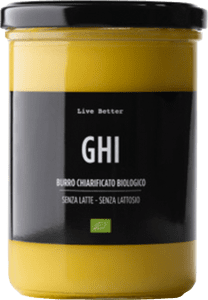
LIVESGhi is made by clarifying butter, that is, by slowly cooking it at a low temperature until protein, water and lactose are removed. What remains is pure fat, with a smoke point of 250°C, due to the presence of as much as 70% saturated fat.
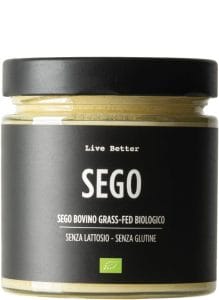
Tallow, on the other hand, is obtained by cooking beef fat at a low temperature. Again, the product obtained is pure fat, with a slightly lower smoke point, 230°C, because it contains less saturated fat, only 50%.
Both contain omega 3 and vitamins A, D, E, K.
Ghi has a milder flavor, tallow a stronger one.
Both contain very little omega-6.
Fun fact: Before the advent of vegetable oils, tallow or lard was used for frying, depending on the animals most available in the geographic area. Until 1990 McDonald's fried its fries in a mixture of 93% tallow and 7% canola oil.