




















 EBOOK
EBOOK Insights
 Blog
Blog Tutorials
 GRASS FED
 training
 LIVES
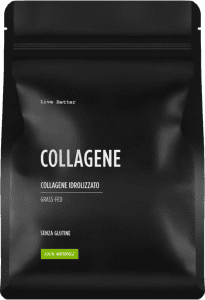
LIVESAll collagen on the market is hydrolyzed. If it were not it would be called gelatin. These are the two products you get from animal collagen.
Let's start at the beginning: collagen is the "glue" that holds the bodies of animals together. In its natural form it is insoluble. Gelatin, what we call "isinglass," is made by partially dredging collagen with heat. Gelatin is soluble in hot water. Collagen powder is obtained through the process of hydrolyzing animal tissues such as bone, skin, and cartilage (our collagen is produced exclusively from the skin of pasture-raised cattle. Collagen powder is soluble in both hot and cold water.
Gelatin forms a gel; collagen does not because it is composed of smaller molecules. Our gelatin has a molecular weight of about 50,000 Da (dalton). Gelatin can have different molecular weights from 20,000 Da to 100,000 Da. The molecular weight of gelatin determines its Bloom, or gelling power; the higher the bloom, the higher the gelling power. Our collagen has a molecular weight between 1,800 Da and 2,000 Da. In contrast, the native collagen molecule (found in animal tissues) has a molecular weight of 300,000 Da.
Why am I telling you all this? During digestion, proteins must be broken down in order to be absorbed; if a protein is smaller in size it is absorbed faster because it is easier to break it down.