






















 EBOOK
EBOOK Insights
 Blog
Blog Tutorials
 GRASS FED
 training
 LIVES
LIVES
IS ERYTHRITOL BAD FOR THE HEART?
REVIEW
Erythritol is a sweetener belonging to the polyol family, naturally occurring in some foods and used for more than 30 years as an alternative to sugar. Compared with other polyols (maltitol, xylitol, etc.) it is the one that is best tolerated in the intestines.
Recently two studies observed that people with high erythritol in the blood had an increased risk of cardiovascular events. Erythritol in the blood can come from the diet but can also be produced by the body when there is metabolic dysfunction (diabetes, insulin resistance, impaired glucose metabolism etc).
No study measures dietary intake of erythritol. Both studies observe that participants with high blood erythritol levels had altered metabolic conditions (diabetes, insulin resistance, obesity, etc.). These metabolic dysfunctions are now recognized as major risk factors for cardiovascular disease.
Erythritol in the blood is a consequence of metabolic dysfunction. Metabolic dysfunction is the real cause of recorded cardiovascular events. So it is logical to find high levels of erythritol in people with higher cardiovascular risk. In fact, the researchers state: erythritol may just be a marker of poor metabolic health.
The media, however, told it differently. Unfortunately, we must be wary of media reports: they are structured to capture our attention through potential danger.
The truth is that erythritol is a safe sweetener, consumed for more than 30 years in Japan and approved in Europe since 2006.
CAUTION: Although erythritol is a safe sweetener, it should not be abused. Accustoming the palate to less sweetness is the most appropriate recommendation for better living.
WHAT IS ERYTHRITOL?
Erythritol (or for chemistry buffs “(2R,3S)-butane-1,2,3,4-tetrol”) belongs to the family of sugar alcohols, also known as polyols (1). It occurs naturally in some mushrooms, fruits and fermented foods. It has been used as a sweetener for more than three decades (2).
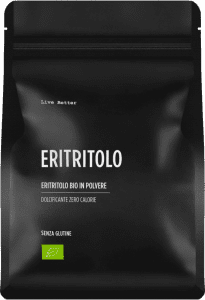
Today erythritol is produced almost exclusively by fermentation, a natural process similar to that used to make yogurt or beer. Production takes place inside large incubators where microorganisms ferment sugars (usually from corn) and turn them into erythritol. WARNING: Erythritol may sometimes contain talc; check the ingredient list. Live Better erythritol does not contain talc.
Erythritol is considered safe by FDA (3) and EFSA (4). EFSA is the European food safety authority; FDA is the U.S. equivalent.
STUDIES ON ERYTHRITOL AND CARDIOVASCULAR EVENTS
We start with an analysis of a study published in Nature Medicine (5) where it appears that higher levels of erythritol in the blood are associated with an increased risk of cardiovascular events.
Let's go through this study, starting with a question: does erythritol in the blood depend on dietary ingested erythritol? No, dietary intake of erythritol was not measured in the study.
Erythritol can be produced by our bodies, and its production increases in situations of metabolic dysfunction such as diabetes, insulin resistance, obesity, hypertension, etc.
It just so happens that these metabolic dysfunctions today are believed to be the main causes of many modern diseases, including cardiovascular diseases (6,7)
In addition to not measuring whether participants had consumed erythritol, there is another important limitation in the study: the blood value of erythritol was measured only once, at the beginning of the study.
Let us now delve into a second study, which evaluated whether blood erythritol levels were associated with increased risk of all-cause mortality and cause-specific mortality (cardiovascular, cancer, stroke) (8).
The study was conducted on 4,468 Finnish male smokers, aged 50 to 69 years, and the follow-up lasted 19 years.
This second study is also very similar to the previous one:
- Study does not measure dietary erythritol intake
- erythritol was measured only at the beginning of the study (a little short since the study lasted 19 years!).
- participants were smokers (risk factor for cardiovascular events)
The authors of the study conclude by stating that erythritol may just be a marker of poor metabolic health.
In a study of 4,000 people, participants with higher plasma erythritol values were older, were more likely to have diabetes, hypertension, hyperlipidemia, and had higher body mass index and cardiac biomarkers, as well as reduced kidney function. The study concludes “circulating levels of erythritol are indicators of cardiometabolic health and cardiovascular outcomes.” (9)
In other words: high levels of erythritol in the blood are a consequence of metabolic dysfunction, which is the real cause of cardiovascular events.
To draw the conclusion from these kinds of studies that erythritol is the cause of cardiovascular events would be like saying, “when there is a fire, there are always firefighters, so firefighters are the cause.” This is yet another example that a correlation (when A occurs, B is also present) does not mean causation (B is the cause of A).
CONCLUSIONS
Analysis of the evidence available today shows that we can rest absolutely assured: these studies do not prove that consuming erythritol is harmful. They simply say that people with higher levels of erythritol in the blood have higher cardiovascular risk because they have metabolic dysfunction (which causes high levels of erythritol in the blood).
In fact, even EFSA in its paper re-evaluating the safety of erythritol, based on experimental data, clinical trials and literature through September 2023, concludes that: No evidence emerges for a cause-and-effect relationship between dietary consumption of erythritol and an increased risk of cardiovascular disease (4).
What is clear from these studies is that erythrol in the blood is an indicator of metabolic dysfunction.
WHY LIVE BETTER USES ERYTHRITOL
1) It is safe: both EFSA and FDA have approved it for human consumption.
2) unlike allulose and monk fruit (not yet approved) erythritol has been approved in Europe since 2006, so it has been safely consumed for 20 years.
3) Of all the polyols, erythritol is the one that creates the least intestinal problems because it has the least laxative power
4) Is a sweetener with zero calories and zero glycemic index
5) It is good, imparts a sugar-like sweetness and has no strange aftertaste
WHY ERYTHRITOL IS THE BEST OF THE POLYOLS
Erythritol is the best tolerated polyol in the intestine: 90% of ingested erythritol is absorbed by the intestine and only a small portion reaches the colon. (10,11) The other polyols, on the other hand, are absorbed only a small part by the intestine, and the rest reaches the colon where it ferments and draws water, causing bloating and diarrhea (12).
This is why erythritol is the best: since only a small portion reaches the colon, the chance of having adverse events (gas/diarrhea) is minimal compared to other polyols. Unfortunately, for those with unhealthy intestines, erythritol can also be problematic.
Here are the %s of intestinal absorption of some polyols:
Erythritol 90% (10,11,13)
Sorbitol 73% (14)
Isomalt 60% (14)
Xylitol 50% (15)
Maltitol 40-60% (16)
Mannitol 18% (17)
Fun fact: The mannite that is used as a laxative is none other than mannitol: only 18% is absorbed in the intestines, the remainder reaches the colon where it draws water, increasing the mass in transit, hence bowel movements, hence evacuation.
Erythritol is a sweetener with zero calories and zero glycemic index. No other polyol has these characteristics (18,19):
Xylitol: 240 kcal per 100 g glycemic index 7-13
Sorbitol: 240 kcal per 100 g glycemic index 9
Mannitol: 160 kcal per 100 g glycemic index 0
Isomalt: 200 kcal per 100 g glycemic index 0
Maltitol: 240 kcal per 100 g glycemic index 35 - 52
I hope that this in-depth study has provided useful information for making informed choices and not being influenced by alarmist headlines that interpret scientific evidence for the sole purpose of generating fear and thus attracting the reader's attention.
For more content based on solid scientific evidence interpreted with rigor and critical sense, keep following us.
Knowledge means freedom
Be informed, be aware, live better
SUGGESTED BOOK
Why We Get Sick, Benjamin Bikman, 2020 (available in English only)
The author in this book identifies insulin resistance as the hidden root of an epidemic that causes or worsens numerous chronic diseases, including cardiovascular disease
BIBLIOGRAPHY
1) https://link.springer.com/book/10.1007/978-1-4757-5380-6
2) https://pubmed.ncbi.nlm.nih.gov/29196787/
3) https://pubmed.ncbi.nlm.nih.gov/26930537/
4) https://pubmed.ncbi.nlm.nih.gov/38125972/
5) https://pubmed.ncbi.nlm.nih.gov/36849732/
6) https://pubmed.ncbi.nlm.nih.gov/40969606/
7) https://pubmed.ncbi.nlm.nih.gov/38455920/
8) https://pubmed.ncbi.nlm.nih.gov/39339699/
9) https://pubmed.ncbi.nlm.nih.gov/39983608/
10) https://pubmed.ncbi.nlm.nih.gov/36077269/
11) https://pubmed.ncbi.nlm.nih.gov/28484010/
12) https://pubmed.ncbi.nlm.nih.gov/28710145/
13) https://pubmed.ncbi.nlm.nih.gov/9862657/
14) https://pubmed.ncbi.nlm.nih.gov/7859694/
15) https://pubmed.ncbi.nlm.nih.gov/40444390/
16) https://www.gastrojournal.org/article/0016-5085(90)90960-9/fulltext
17) https://pubmed.ncbi.nlm.nih.gov/40014070/
18) https://eur-lex.europa.eu/legal-content/IT/TXT/PDF/?uri=CELEX:32008L0100
19) https://pubmed.ncbi.nlm.nih.gov/19087388/


Leave A Comment