





















 EBOOK
EBOOK Insights
 Blog
Blog Tutorials
 GRASS FED
 training
 LIVES
LIVES
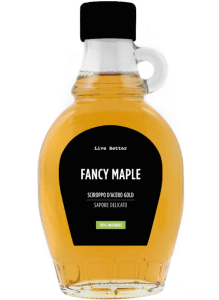
MAPLE SYRUP
I have always been fascinated by maple syrup, ever since I was a child watching it being poured over pancakes in American movies. When I finally tasted it for the first time, I fell in love with it instantly. I have always found it fascinating because it is obtained from the sap of around 150 tree species, although almost all production comes from sugar maple (70%) and red maple (29%).
These maple trees are typical of cold climates. During the warm season they store starch in the trunk and roots. When spring begins, the starch is converted into simple sugars that rise through the sap to the branches, where they nourish the leaves.
It was Native Americans who first introduced maple syrup to Europeans.
Maple sap is collected only for a few weeks each year, between the end of winter and the beginning of spring, when daytime temperatures are above freezing and nighttime temperatures fall below zero. The bark is tapped and the sap is collected, then heated to evaporate the water until the syrup contains at least 66% sugars.
To produce 1 liter of maple syrup, about 40 liters of sap are required.
Canada produces 71% of the world’s maple syrup, with 90% of that coming from Québec. The remaining 29% is produced in the United States, mainly in Vermont.
In this video you can see how maple syrup is produced today and how it was made in the past.
NUTRITIONAL VALUES
Maple syrup contains only carbohydrates and no other macronutrients, like most sweeteners. It consists mainly of sucrosesimilar to white sugar. Unlike white sugar, however, it also contains vitamin B2 and minerals such as manganese, zinc, potassium, magnesium and calcium.
30 grams of maple syrup – the amount I use in the kaiserschmarren Live Better style (with a full 48 grams of protein), provide:
36% of the recommended daily allowance (RDA) of manganese
13.5% of the RDA of vitamin B2
8.5% of the RDA of copper
3% of the RDA of calcium
Its mineral content makes maple syrup a good natural remineralizing option for athletes.
Maple syrup also contains polyphenols with antioxidant, antiproliferative and antimutagenic properties(Study)
Other benefits traditionally associated with maple syrup,without scientific evidence):
Supports digestion
Helps regulate bowel function
Stimulates diuresis
Stimulates thermogenesis
Detoxifying effect
Anti-inflammatory properties
GLYCEMIC INDEX
This topic can be confusing, as different sources report different values. Here I will refer to the values reported on glycemicindex.com from the University of Sydney. glycemicindex.com University of Sydney.
The glycemic index depends on the types of sugars present in a food. Fructose has a lower impact on blood sugar, while glucose raises it more significantly. The proportions of these sugars determine the glycemic index.
Glucose, 97
Cane sugar (panela), 69
Wildflower honey, 37–84
Chestnut honey, 66
Manuka honey, 54–65
Brown sugar, 60
White sugar, 59
Maple syrup, 54
Coconut sugar, 54
Acacia honey, 53
Fructose, 20
Agave syrup, 19
CLASSIFICATION
Lo Maple syrup is classified under strict Canadian regulations into two grades, Grade A or Processing Grade, and four color classes: Gold, Amber, Dark and Very Dark.
Only maple syrup classified as Grade A can be sold at retail to consumers.
Grade A maple syrup is obtained exclusively from the concentration of maple sap and must meet the following requirements:
free from unwanted fermentation
clear and uniform in color
free from sediment
not cloudy
with a natural maple aroma characteristic of each color class
free from off-odors or off-flavors
“Processing grade” maple syrup does not meet one or more of the quality parameters required for Grade A and can only be used for industrial production.
THE FOUR VARIETIES
Grade A maple syrup is further divided into four varieties, each with different colors and flavors. The variety is determined by its transmittance value, which is the ratio between the intensity of light passing through the sample and the light exiting it. Higher transmittance means a lighter, clearer syrup, while lower values indicate a darker, more opaque syrup. The different colors also correspond to different flavors and densities.
Each color variety is identified by a name and a flavor note:
Gold – delicate taste
Amber – rich taste
Dark – robust taste
Very Dark – strong taste
Nature itself determines the nuances of maple syrup. At the beginning of the harvesting season, the syrup is lighter with a delicate flavor. As the season progresses, the syrup becomes darker with more intense aromatic notes.
The four maple syrup varieties have different sensory characteristics, making them suitable for a wide range of preferences.
GOLD COLOR – DELICATE TASTE
This is the first variety produced at the beginning of the season, during the coldest period, usually in late February. It has a golden color, a delicate flavor and low density. It is the most prized variety and is produced in smaller quantities than the others.
Thanks to its light and refined taste, it is ideal on its own, on pancakes, in yogurt, on bread or in beverages. It also enhances savory ingredients and pairs well with young cheeses or in salad dressings.
AMBER COLOR – RICH TASTE
The second variety of the season, typically produced in March. It has an amber color, low density and a rich, aromatic flavor with notes of brown sugar and hazelnut.
Thanks to its fruity notes, it is an ideal companion for a wide range of breakfasts. It pairs perfectly with yogurt, fresh fruit, cocktails, as well as classic pancakes or waffles. It is also often used to glaze foods during cooking, such as fish.
It goes well with yogurt, fresh fruit, in cocktail preparation, as well as on classic pancakes or waffles. Also often used for glazing in cooking foods, such as fish.
DARK COLOR – ROBUST TASTE
The third variety, produced from sap collected in April.
It has a dark amber color, medium density and a bold flavor with notes of hazelnut and caramel.
This is the most versatile and widely appreciated variety, excellent in both sweet and savory preparations. Ideal in fruit-based recipes, to sweeten coffee, to glaze meat or vegetables, or in BBQ sauce.
VERY DARK COLOR – STRONG TASTE
The final variety produced at the end of the harvesting season, in late April.
It has a very dark color, a thicker consistency and an intense flavor with caramel and licorice notes. It is best suited for those who enjoy strong, persistent flavors and works perfectly as a molasses substitute.
When used in desserts or beverages, it releases its distinctive flavor and is often used as an ingredient in the confectionery industry. Thanks to its intense taste, it also pairs very well with aged cheeses.


Leave A Comment