






















 EBOOK
EBOOK Insights
 Blog
Blog Tutorials
 GRASS FED
 training
 LIVES
LIVES
PROTEIN LEVERAGE HYPOTHESIS
During the live broadcast on functional nutrition, Dr. Luca Orlando Meo talked about the protein leverage hypothesis: as long as a human being has not consumed a certain amount of protein, he or she will continue to be hungry.
I found the hypothesis very interesting, so I decided to look into it. The researchers who had formulated it had written a book “Eat like the animals,” so I bought it. Wow!
I think it is one of the most interesting books on nutrition that I have read in recent years, and just think that the researchers who wrote it, David Raubenheimer and Stephen Simpson, are two ethnomologists (insect scholars)!
They have done a lot of experiments on locusts, cockroaches, gnats, mice, and humans that allowed them to formulate an intriguing hypothesis: until we consume a certain amount of protein, we will continue to be hungry.
The problem is that the mainly grain-based Western diet contains a low percentage of protein, so we will have to consume more calories to meet needs. The two researchers speculate that this is the cause of the modern obesity epidemic!
Let me tell you about one of the experiments: in the first phase, participants could consume as much food as they wanted from a buffet that included a wide variety of foods. Although everyone ate different things, they all consumed about 18% of protein! In the second phase, people were divided into two groups: high-protein or low-protein menus.
Also in this phase of the experiment, all participants consumed about 18% of protein, but compared with the first phase:
- The high-protein group consumed 38% fewer calories
- the low-protein group consumed 35% more calories
This behavior has also been observed in other experiments with humans and animals: each species has a certain need for protein that must be introduced with food and will continue to eat until it has reached it.
If the food is high in protein fewer calories will be consumed than if it is low in protein.
Let's take an example (I do it with only 1 food so it's easier)
If the protein requirement is 70 g of protein per day, we can achieve it by eating
- 343 grams of anchovies = 450 kcal (100 g anchovies contain 20 g protein and 131 kcal)
- 536 grams of spaghetti = 1,991 kcal (100 g of spaghetti contains 13 g of protein and 371 kcal)
There is an abysmal difference in terms of calories! So imagine the weight consequences of eating a diet with low protein intake....
But so is it better to eat LOTS of protein?
From experiments conducted by researchers, the answer is no. The percentage that appears to be optimal varies depending on the period of life an animal is in. For humans, it SEEMS* that these are the optimal protein values:
- Children and adolescents: 15%
- 18 - 30 years old: 18%
- 30 - 40 years old: 17%
- 40 - 65 years old: 15%
- After age 65: 20%
- Pregnancy and lactation: 20% protein
*I wrote “seems” in that there are still no certainties in the nutritional field, and I want to emphasize this so that no one gets all worked up over this or that theory.
Caloric requirements are influenced by physical activity and muscle mass, so a highly trained person with a lot of muscle mass will have higher caloric requirements than a sedentary person of the same age and weight. Since protein requirement is a % and of the caloric requirement, the higher the caloric requirement the more grams of protein needed.
Example: take two women, they are 45 years old, both weigh 57 kg and are 165 cm tall
- Sedentary, caloric requirement 1,550 kcal, 15% protein = 58 grams of protein (1 g/kg weight*)
- Sportswoman, caloric requirement 2,227 kcal, 15% protein = 102 grams protein (1.8 g/kg weight*)
*You know when you hear that you need to eat 0.8 grams of protein per kg of body weight? That number is the MINIMUM amount needed to stay healthy. I would like to remind you that based on urea synthesis capacity, it is estimated that a healthy adult can tolerate 3.5 g of protein per kg of body mass without side effects (2).
15% OF PROTEIN IS THE OPTIMAL AMOUNT?
It depends on what the goal is: longevity or reproduction?
In recent years much research has led to the idea that calorie restriction could lead to longer life spans. From the data emerging from the experiments of Raubenheimer and Simpson it would seem that this benefit on longevity is due to protein restriction and not caloric restriction. Animal longevity was greatest when protein accounted for 15% of caloric requirements. When this % increased, life length decreased. There was a little problem, however, when animals consumed the 15% of protein they reproduced less. As if the 15% of protein was not enough for the body to ensure effective reproduction. What I found incredibly fascinating was that when the animals were allowed to feed freely, they were consuming exactly the amount of protein that maximized reproduction: in the animal world, reproducing is the main goal of life.
It is evident that for us human beings this is no longer the case.
Please note: animals that consumed the protein 15% slowed down their development, which is why they lived longer. It was as if they were not at their full potential.
Plus there is another key point: these are animal studies, which however many genes they may have similar to ours, they are not human beings. Let me give you an example: in the mouse experiment those who lived the longest consumed 15% of protein, lots of carbohydrates, little fat, and were obese. However, obesity in humans increases the risk of mortality. So you can't generalize. What is good for mice is not always good for humans.
So as is often the case with scientific findings: you have to take them with a grain of salt. Also because researchers, being human beings, often have biases.
What is clear from these studies is that there is a MINIMUM amount (15%) of protein that our bodies need to take in on a daily basis and that we will be hungry until we have reached it.
I would say that already this information is crazy!
Give it a try.
Calculate your calorie requirements at this link
Example: 1776 kcal
Take the value “calories needed to maintain weight) and multiply it by 0.17 (i.e. 17%)
Example: 1776 x 0.17 = 302 kcal must come from protein
Now divide this value by 4 (which are the calories contained in 1 gram of protein)
Example: 302 : 4 = 75 grams of protein
Now try to consume these grams of protein and observe whether you are still hungry afterwards
If you want to try to increase the % of protein you have to change the number 0.15
0.17 = 17% protein
0.2 = 20% protein
What about the remaining 85% of calories how do we take them in?
Dr. Cazzavillan in Monday's live broadcast would advise you.
- 5% carbohydrates
- 80% fats
so you would be in ketogenic 😉
But the truth is that this choice is up to you. No one to date knows what the optimal subdivision is.
Try it!
If you want to keep carbs within 100 g per day (which would be a low-carb light) then consider 400 kcal from carbs (because carbs also contain 4 kcal per gram).
I remind everyone that the more muscle mass you have, the more your body will have no problem handling carbohydrates. On Monday's live broadcast, Dr. Cazzavillan reported that Dr. Dominic D'Agostino (very muscular) was able to stay in ketosis by eating 150 g of carbohydrates a day!
Returning to our example from before then we would have
- 75 g protein = 302 kcal = 17% of caloric requirement
- 100 g of carbohydrates = 400 kcal = 22% of the calorie requirement
- 119 g of fat = 1074 kcal (fat contains 9 kcal per gram) = 60% of caloric requirement
To do these calculations you need an app. There are so many, I am using Fat Secret
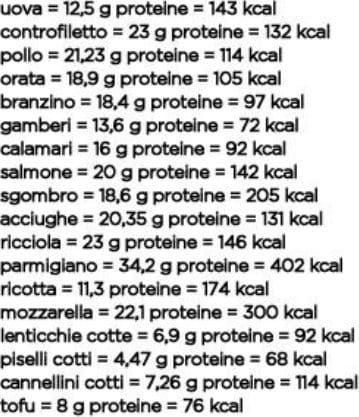
I also report the protein content of some foods. Please note: the noble proteins, eggs, meat, fish and dairy products, have the highest protein content. Dairy products could cause problems for some people because of lactose (which many people cannot digest) and caseins (which could cause inflammation). They also contain caseomorphins which are similar to morphine, cause some problems and are addictive. If you want to go more in depth you can find a good article here. The advice is to consume them in moderation.
How much protein and calories do 100 g of...
BIBLIOGRAPHY


Leave A Comment