

























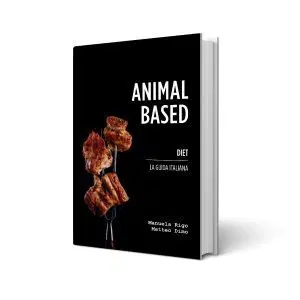
 EBOOK
EBOOK Insights
 Blog
Blog Tutorials
 GRASS FED
 training
 LIVES
LIVES
PROTEINS
I would like to begin this in-depth look with a premise: knowledge is constantly evolving. What we believe to be true today may be disproved by future scientific discoveries. That’s why I try to keep an open mind, and when I realize that my beliefs don’t match reality, I’m the happiest person in the world — because for me, the most important thing is truth, not “being right.”
What is the most appropriate diet for human beings? Unfortunately, there is still no definitive answer. In fact, opinions on the subject are often completely opposite. So, what do I eat? To answer this question, I have chosen an evidence-based approach.
The first question I asked myself was: what is the body of an adult made of? (1)
60% water
16% fat (varies between men and women)
16% proteins
6% minerals
1% carbohydrates
Now, I invite you to reflect: if only 1% of our body is made of carbohydrates, why do the guidelines suggest that 50–60% of our calories should come from carbs? What are they for?
WHAT ARE PROTEINS
The word protein comes from the Greek proteos, meaning “of primary importance.”
When we think about proteins, the first things that come to mind are skin and muscles, but proteins carry out countless functions in our body:
- structural: collagen in connective tissue, elastin in skin, keratin in nails and hair
nails and hair
- protective: antibodies
- transport: hemoglobin that carries oxygen, lipoproteins (HDL and LDL) that carry cholesterol
colesterolo
- storage: ferritin that captures iron recovered by the spleen from red blood cells
- contractile: actin and myosin in muscles
- enzymatic: amylase that breaks down starch during digestion
- hormonal: insulin to lower blood sugar
These are just some examples in fact, our body contains over 30,000 different proteins!
Note: collagen represents about 30% of the proteins in the human body. It is found mainly in the skin, but also in muscles, tendons, blood vessels, cartilage, teeth, bones, and corneas.
HOW PROTEINS ARE MADE
Proteins are macromolecules made up of chains of amino acids. Imagine them like a pearl necklace, where each pearl is an amino acid.

Think about this: the more than 30,000 proteins in the human body are built using only 20 amino acids.
These 20 amino acids are classified as:
Essential: the body cannot produce them, so they must come from food
Conditionally essential: the body can produce them, but not always in sufficient amounts (e.g. in cases of illness, stress, etc.)
Non-essential: the body produces them in adequate quantities
We talked about glycine as a conditionally essential amino acid in the article on glycine and collagen, which you can find here.
It’s important to highlight that amino acids are needed not only for protein synthesis, but also for the production of other fundamental substances such as glutathione, creatine, nitric oxide, dopamine, serotonin, RNA, DNA, and more.
PROTEIN TURNOVER
Protein turnover is the process through which the body breaks down some proteins and synthesizes new ones every day. During this process, some amino acids are irreparably damaged and must be replaced through diet (4).
ATTENTION: The more protein we consume, the greater the protein turnover (4).
The body never does anything useless or wasteful: protein turnover is essential to ensure that proteins are “well built” and able to perform their functions.
Consuming too many sugars triggers protein glycation, which makes proteins unusable. Remember that carbohydrates (bread, pasta, rice, legumes, vegetables, fruit, sugar, etc.) are sugars. I invite you to look at Dr. David Unwin’s infographics, which you can see here.
You’ll find a couple on the next page, and many more on the website.


Now let’s begin analyzing the excellent video “Protein is not protein. Here’s why” from the YouTube channel What I’ve Learned, which you can watch here (unfortunately only available in English).
NOT ALL PROTEINS ARE EQUAL
In 2013, the FAO proposed a new method to define protein quality: the DIAAS (Digestible Indispensable Amino Acid Score) (5). This method measures protein quality by considering both digestibility and the amount of essential amino acids an ingredient provides.
For example, we can get 18 g of protein by consuming the following foods (DIAAS score and calories shown in parentheses):
198 g lentils (54%, 232 kcal)
48 g bread + 45 g peanut butter (43%, 385 kcal)
163 g soybeans (edamame) (99%, 198 kcal)
85 g beef steak (112%, 114 kcal)
3 eggs (113%, 192 kcal)
In the image below, you see two meals that both provide 54 g of protein. On the left, all plant-based proteins; on the right, all animal-based proteins. As you can see, the plant-based meal requires almost double the calories to deliver the same amount of protein compared to the animal-based one!

THE LIMITING AMINO ACID
Now we need to introduce a very important concept: protein synthesis is limited by the essential amino acid that is present in the smallest amount (called the limiting amino acid).

To better understand this mechanism, we can use Liebig’s barrel, which comes from Liebig’s “law of the minimum” (6): growth is controlled not by the total amount of available resources, but by the scarcest one.
In this example, the staves of the barrel correspond to the different essential amino acids, and the water corresponds to the amount of protein that can be synthesized. The barrel on the left holds little water because the stave for methionine is very low, so only a small amount of protein can be synthesized. If we increase the available methionine (right), the barrel can hold much more water meaning more protein can be synthesized.

Back to the previous example: the graphs show the essential amino acid content of the two meals, and the blue line indicates how many of them we can actually use. As you can see, in the plant-based meal the limiting amino acid is methionine, which drastically reduces the usability of the other essential amino acids present, resulting in limited protein synthesis.
In the animal-based meal, however, we can utilize many more essential amino acids and synthesize a lot more protein! So while both meals provide 54 g of protein, with the plant-based meal we may be able to use only about half.
WARNING:
Animal proteins have traditionally been called “noble proteins” because they contain an amount of essential amino acids appropriate to the needs of the human body.
HOW MUCH PROTEIN TO CONSUME (GUIDELINES)
The LARN tables (reference intake levels for nutrients and energy) issued by the Italian Society of Human Nutrition are the official guidelines for a healthy diet, according to the consensus of most of the scientific community as of 2022.
There is, however, a small part of this community that holds different views and is fighting to change things (7). It will likely take time for this change to occur… which is why I fully embrace the motto of the amazing Dr. Cristina Tomasi: “Be the protagonists of your own health!”
According to the LARN tables, a 45-year-old woman like me has an average requirement of 0.71 g of protein per kg of body weight. The LARN estimate is that I weigh 60 kg, which means they recommend 43 g of protein per day. However, in the next column they say the “recommended intake” is 0.9 g/kg, or 54 g of protein per day. Why the difference?
Because 0.71 g/kg is the minimum needed to maintain health (8).
For people over 60, the LARN tables recommend 1.1 g/kg of body weight, which equals 66 g of protein for women.
HOW MUCH PROTEIN TO CONSUME (UPDATED VIEW)
Here’s my reasoning:
1) The more protein we consume, the higher the protein turnover (4).
2) A new protein works better than an old one.
3) Our body has over 30,000 proteins with countless functions.
4) The older the proteins, the less efficient they are.
5) To have new, efficient proteins, all we need to do is eat more protein.
This is just my reasoning, so let’s see if science supports it.
In this study (9), summarizing the presentations at the 2015 “Advances in Protein Nutrition” conference by the Canadian Nutrition Society, it was stated that higher protein intake appears to have several positive effects on health:
– Helps with healthy aging
– Regulates appetite
– Supports weight control
The suggested intake in this study is 1.2 to 1.6 g/kg of body weight.
Other studies indicate that higher protein consumption leads to:
Greater bone density (10)
Reduced risk of hip fractures (11)
Better growth in children (12)
DO TOO MANY PROTEINS HARM YOU?
This is one of the most common questions we get during our live sessions.
The main concern is about the kidneys. However, in the 2005 edition of the U.S. Dietary Guidelines (13), in the section on “high-protein diets,” the supposed risks of high protein intake are listed.
Here are the exact words from the document:
Osteoporosis
It was recently concluded that there is no need to reduce protein intake. On the contrary, insufficient protein leads to bone loss, while higher protein consumption increases calcium intake and if calcium intake is sufficient, no bone loss occurs.
Kidney failure
Scientific evidence suggests that lower protein intake reduces kidney function. It is therefore concluded that protein intake is not responsible for the age-related decline in kidney function.
SO HOW MUCH PROTEIN SHOULD WE EAT?
The U.S. guidelines (on which many others are based) report the following acceptable macronutrient distribution ranges (13):
di macronutrienti (13)
Carbohydrates: 45–65%
Fat: 20–35%
Protein: 10–35%
Let’s take an example:
A 45-year-old woman like me has a daily calorie requirement of 1,600 kcal.
If 30% of those calories come from protein, that equals 480 kcal.
Since 1 g of protein = 4 kcal, this means 480 kcal = 120 g protein.
I weigh 57 kg. If I divide 120 g by 57 kg, the result is 2.1 g protein per kg of body weight. Too much?
Troppo?
Let’s find out.
IS THERE A DAILY LIMIT?
This study (14) reports very interesting data:
– based on urea synthesis capacity, researchers estimate that a healthy adult can tolerate 3.5 g of protein per kg of body weight without side effects (15). For an 80 kg person, this equals 280 g of protein. Greenland Eskimos have lived for generations on a diet almost exclusively based on meat, consuming daily about 280 g protein, 135 g fat, and 54 g carbohydrates with no kidney or liver problems.
– based on scientific literature, researchers suggest a safe intake of 2–2.5 g protein per kg of body weight (15). (15).
So, going back to my example, 2.1 g of protein per day is perfect!
HOW TO CALCULATE PROTEIN GRAMS
I weigh 57 kg. So if I want to consume 2.1 g of protein per kg, I should eat 119.7 g of protein. But does that mean eating 119.7 g of eggs, meat, or fish?
Absolutely not! The 119.7 g refers to the protein content listed on nutrition labels. For example:
100 g eggs = 12.5 g protein = 143 kcal
100 g beef sirloin = 23 g protein = 132 kcal
100 g chicken = 21.23 g protein = 114 kcal
100 g sea bream = 18.9 g protein = 105 kcal
100 g sea bass = 18.4 g protein = 97 kcal
100 g shrimp = 13.6 g protein = 72 kcal
100 g squid = 16 g protein = 92 kcal
100 g salmon = 20 g protein = 142 kcal
100 g anchovies = 20.35 g protein = 131 kcal
100 g mackerel = 18.6 g protein = 205 kcal
100 g amberjack = 23 g protein = 146 kcal
100 g collagen powder = 90 g protein = 369 kcal
100 g cooked lentils = 6.9 g protein = 92 kcal
100 g cooked peas = 4.47 g protein = 68 kcal
100 g cooked cannellini beans = 7.26 g protein = 114 kcal
100 g tofu = 8 g protein = 76 kcal
Remember: plant proteins don’t contain all essential amino acids. So if you follow a vegetarian or vegan diet, it’s important to combine different protein sources to provide your body with all the essential amino acids it needs.
I hope this overview helps you understand how important protein is for our health. Even in the live session “Epigenetics and Health”, Dr. Lucia Aronica said that protein should be at the center of every meal. Watch the session here
BIBLIOGRAPHY
- https://www.britannica.com/science/human-nutrition/BMR-and-REE-energy-balance
- https://it.wikipedia.org/wiki/Amminoacido
- http://www.humanproteomemap.org/
- https://www.ncbi.nlm.nih.gov/books/NBK234922/
- https://www.fao.org/ag/humannutrition/35978-02317b979a686a57aa4593304ffc17f06.pdf
- https://it.wikipedia.org/wiki/Legge_di_Liebig
- https://www.nutritioncoalition.us/
- https://www.researchgate.net/publication/7003706_A_Review_of_Issues_of_Dietary_Protein_Intake_in_Humans
- https://cdnsciencepub.com/doi/pdf/10.1139/apnm-2015-0550
- https://www.tandfonline.com/doi/full/10.1080/07315724.2017.1322924
- https://www.sciencedirect.com/science/article/pii/S2001037019301448
- https://publications.aap.org/pediatrics/article/140/1/e20163459/37999/Eggs-in-EarlyComplementary-Feeding-and-Child?autologincheck=redirected
- https://nap.nationalacademies.org/catalog/10490/dietary-reference-intakes-for-energycarbohydrate-fiber-fat-fatty-acids-cholesterol-protein-and-amino-acids
- https://pubs.rsc.org/en/content/articlehtml/2016/fo/c5fo01530h
- https://pubmed.ncbi.nlm.nih.gov/16779921/

Hi Elena, very interesting article!
One question: Does weight (which I read on the scale) or lean mass weight intervene in the calculation of protein requirements?
Thank you very much
xxx
It depends on the multiplier you use. With respect to what is reported in this email, you can consider the fitness weight.