





















 EBOOK
EBOOK Insights
 Blog
Blog Tutorials
 GRASS FED
 training
 LIVES
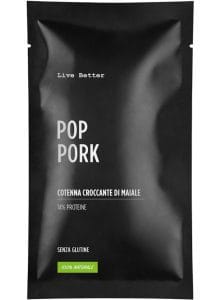
LIVESPork rind is by far the food richest in collagen, and collagen is not a protein with high biological value because it does not contain essential amino acids in sufficient quantities. In an optimal diet, collagen should not account for more than 30% of daily protein intake. If this limit is exceeded, nothing bad happens—just think of the millions of vegans around the world (plant-based proteins also do not contain sufficient essential amino acids). However, if we want to optimize our diet—and our health—we need an adequate intake of essential amino acids; therefore, collagen should account for no more than 30% of our daily protein intake.
Example
Daily protein intake 100 g (woman 60 kg, 1.6 g of protein per kg of body mass, considering ideal weight)
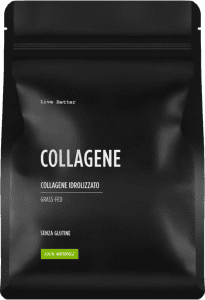
Maximum collagen quota 30 g, which is equivalent to 32 g of collagen or 30 g of Pop Pork
Protein intake 130 g (man 80 kg, 1.6 g protein per kg body mass, considering ideal weight)
Maximum collagen quota 39 g, which is equivalent to 42 g of collagen or 52 g of Pop Pork
If your protein intake is higher, you can increase the grams of collagen consumed daily.