

























 EBOOK
EBOOK Insights
 Blog
Blog Tutorials
 GRASS FED
 training
 LIVES
LIVES
OBJECTIONS TO THE EFFECTIVENESS OF COLLAGEN
The main objections to the effectiveness of collagen supplementation are:
It is not absorbed whole
Vitamin C is needed to absorb it
Protein is enough
20 grams is very little
Studies are funded by the companies that produce it
Has low bioavailability
It is not a complete protein
Let's go and analyze them one by one to see if they are well-founded. I will try to be very rigorous and so I am sorry but I cannot be concise. As always I would like you to UNDERSTAND, not BELIEVE me.
Numbers in parentheses are citations to scientific articles found in the bibliography.
Let's start by analyzing a recent post “3 Reasons Why You Don't See Results with Collagen.”
1. The collagen molecule is too large and is degraded by gastric juices.
No company that sells collagen claims that it is absorbed whole because all collagen on the market is hydrolyzed, that is, cut into smaller molecules, so it is impossible even to be absorbed whole because it is not whole to begin with.
I could stop here, but I will take the opportunity: collagen is a protein, and proteins are molecules too large to be absorbed by the intestinal wall. During the digestive process, all proteins are “cut” into the individual amino acids of which they are made. The amino acids are small and therefore can be absorbed by the intestinal wall.
Note to nerds: In fact, the intestinal wall can also absorb dipeptides and tripeptides, molecules consisting of two or three amino acids. The PepT1 transporter, expressed on the border of enterocytes, is the dominant mechanism for the absorption of peptides from the intestinal lumen. Its binding cavity is piccol, so it can transport only single amino acids, dipeptides or tripeptides.
2. Lacks essential cofactors (vitamin C, zinc, copper, antioxidants) that activate its synthesis.
A cofactor is a substance that is strictly necessary for an enzyme to function. The only cofactors essential for collagen synthesis in humans are: vitamin C, iron, copper, oxygen, and α-ketoglutarate. The person who wrote this post named essential cofactors that actually are not.
We have certainty that the shortage grave e prolonged of vitamin C causes poor collagen synthesis and thus scurvy, but does a supplement vitamin C improve/increase collagen synthesis? There is no certainty, studies on humans have never given conclusively convincing results. I do supplement when in doubt, it is good for so many other things as well.
What about zinc? It indirectly promotes connective tissue synthesis and quality, but does not participate as an essential cofactor in key enzymes.
We also mention silicon: it is not essential to collagen synthesis. It may have indirect effects (fibroblast proliferation, connective tissue quality, etc.), but it is not part of enzyme catalysis.
Caution: supplementing minerals of which we have no real deficiencies can be toxic in some cases.
3. Although absorbed, collagen does not go directly to the skin. The body uses it where it is needed most.
For me, consistency is most important: in point 1 he claimed that collagen was not absorbable, now he considers the possibility that it is. This is not good.
Let's clarify this further: collagen is not absorbed whole, but we absorb the amino acids of which it is made.
It is true that the body uses nutrients where it needs them most. This is true for any substance. Let's take an example with collagen: the 30% of bones is collagen; it is the scaffolding on which minerals are deposited. It is more important for survival to have strong bones than wrinkle-free skin, so if the bones are weak the body will use the amino acids in collagen to strengthen the bones, and not to improve our wrinkles.
VITAMIN C IS NEEDED TO ABSORB IT
No, it is a protein and needs nothing to be absorbed except good digestion: acid stomach and enzymes. Vitamin C is needed to synthesize it, as seen above.
PROTEIN IS ENOUGH
“Do you drink blood to make blood? Do you eat bones to make your bones? We make collagen with what we eat. Just eat protein, animal or vegetable, both are fine.”
To understand the fallacy of this reasoning, we need to understand what collagen looks like: a protein consisting of a triple helix twisted onto itself. The amino acid that allows this triple helix to twist on itself is glycine, the smallest amino acid in existence.
Glycine represents 33% of the amino acids needed to produce collagen. Glycine can be produced by our body, but more and more experts believe that the amount produced by the body is not enough, especially in cases of: obesity, diabetes, fatty liver, insulin resistance,, inflammation, high level of oxidative stress, low protein intake, malnutrition, advanced pregnancy, and exposure to xenobiotics (1,2).
Glycine is so important because it is needed by our body to produce: collagen, glutathione (the most powerful antioxidant produced by our body), creatine, heme group, nucleic acids, and uric acid. In addition, glycine plays an important metabolic, neurological, inflammatory, and antioxidant role. (3)
The foods richest in glycine are:
gelatin/collagen
pork rind
pig's feet
chicken feet
chicken/fish skin
gelatinous bone broth
Other proteins contain very little glycine, here an official USDA list. So no, it is not enough to eat animal or vegetable protein.
In order to provide our body with a good dose of glycine, it is not necessary to take collagen, just include the above-mentioned foods in your diet. I take collagen because it is practical, I put it in kaiserschmarren instead of flour, in yogurt, in a soup, ...
IMPORTANT: As we age, protein synthesis (and thus collagen synthesis) decreases but we can sustain it and keep it at a good level if we eat sufficient protein (at least 1.5 g per kg of body weight ideal). Taking collagen is an easy and practical way to have a good protein intake. Caution: collagen protein should not exceed 25/30% of daily protein intake as collagen is not a complete protein.
20 GRAMS IS VERY LITTLE
Another objection you often hear “a 60 kg body contains about 4 kg of collagen. What difference do you want a 20 g sachet to make?”.
Here we need to introduce the concept of protein turnover: all proteins found in our bodies are renewed. What this means. Old proteins are “taken apart” and then new ones are recreated. This process happens continuously, but proteins in the body have different rates of renewal. Collagen renews very slowly, every year it renews itself:
4,5% of the collagen present in the skin
less than the 1% than the cartilaginous one
3-4% of what we find in the bones. (4,5)
For comparison: the 100% of intestinal wall cells is renewed every 4 to 5 days. (6)
So 20 grams of collagen is not a small amount, because collagen is a protein that is renewed very slowly. This is the reason why it takes time to see the results of collagen supplementation.
Taking 2.5 g a day, on the other hand, is far too little.
CONFLICT OF INTEREST
More than 20,000 scientific papers (7) on different aspects of collagen have been published in recent years, and dozens were articles on the effectiveness of collagen supplementation. However, detractors say they are not good because they are sponsored by collagen companies.
There is a problem here: these detractors do not criticize the efficacy of a drug because the studies were funded by the companies that produce them. How come? Maybe they don't know?
Before a drug is placed on the market, it must receive approval from regulatory bodies, in Italy AIFA. First the drug must be tested in the laboratory and on animals. If all goes well, it moves on to human trials, which are divided into 3 phases. If these are also successful, the company can apply for approval. All these stages are clearly funded by the company that will produce the drug. The costs of this process range from hundreds of millions up to billions of €. Novo Nordisk says it has invested more than 10 billion for Ozempic and Wegovy.
So why are studies funded by collagen companies not reliable while those funded by drug companies are?
Even the studies showing that MAPs go into protein synthesis at 99% were funded by Moretti, the researcher and entrepreneur who produces and markets them. It is perfectly normal for the company that produces a product to fund its research. Unfortunately, states invest very little in scientific research, so there is very little independent research.
VERY LOW BIOAVAILABILITY
One pharmacist stated “collagen does not work because it has very low bioavailability.”
Bioavailable means how easily the different substances in a food are absorbed by the body.
Example: animal proteins are highly bioavailable, while plant proteins are not because they also contain substances that make their digestion and absorption more difficult:
1) In vegetables, proteins are encapsulated in fiber-rich cell walls, which reduce their accessibility to digestive enzymes.
2) Legumes, cereals, seeds and nuts contain substances that may reduce the absorption of some substances they contain:
Phytates: make mineral absorption difficult and interfere with digestive enzymes
Tannins: reduce protein digestion
Trypsin inhibitors: hinder the enzymes that digest proteins
Animal protein, on the other hand, is highly bioavailable because:
(1) Digestive enzymes (pepsin, trypsin, etc.) recognize and break down animal proteins efficiently and easily. (8) So proteins are “cut” well, amino acids are free and can be absorbed.
2) Absence of antinutrients-as we have seen, vegetables contain compounds that interfere with protein digestion. In animal proteins these compounds are absent. (9)
Collagen is an animal protein and therefore has a very high bioavailability.
Fun fact: Gluten is a VERY large protein made up of other proteins. When we eat gluten we digest it only partially, gliadin and glutenin (two proteins found in gluten) remain intact and undigested. This means that we cannot absorb all the amino acids that gluten is made up of. So gluten has low bioavailability. I take this opportunity to mention that humankind has been eating meat for at least 2.5 million years, while it has been eating grains and legumes for only 9,000 years.
Note to nerds: gliadin is a major contributor to leaky gut (permeable gut) binds to intestinal cells (12) and results in the production of zonulin, which in turn results in the opening of tight junctions. Now the intestinal wall is no longer an effective barrier and substances that should not cross it, creating inflammation.
LOW BIOLOGICAL VALUE
Perhaps the pharmacist mentioned above meant that collagen has a low biological value. This is true and is precisely the reason why it is supplemented: collagen contains amino acids that are not found in other proteins in significant amounts, mainly glycine, but also proline.
Proteins with high biological value are defined as those that contain all essential amino acids in the appropriate proportions to meet the needs of the human body.
The most modern method for assessing the biological value of proteins is the DIAAS Digestible Indispensible Amino Acid Score, in Italian “indispensable amino acid digestibility score,” published by the FAO in 2013 (10).
The proteins with the highest biological value according to DIAAS score are: (11)
Milk powder 144
Bacon 142
Concentrated milk protein 141
Pork loin 139
Whey protein concentrate 133
Beef rib 130
Ham 126
Whey protein isolate 125
Eggs 122
Dried beef (jerky) 120
Soybean meal 105
Ground Beef 99
Soy protein isolate 98
Peas 88
Ceci 71
Rice 60
Peanuts 43
Oats 43
Whole wheat 20
SUPPLEMENT ONLY GLYCINE?
I am often asked “since glycine is so important, couldn't that be supplemented directly?” Yes of course you can, moreover it is sweet, very pleasant! I always prefer a food over a supplement. I prefer eggs, fish and meat over essential amino acids, and I prefer collagen over glycine. Everyone is free to make their own choices.
If you still have more questions about collagen, I invite you to read the in-depth “Is it necessary to take collagen?”. And if you want to go even further down the great rabbit hole, read also. this.
TRY IT TO BELIEVE
Millions of people worldwide take collagen every day with benefits on skin, joints, hair, nails, bones, tendons, gut, and sleep. Do you want to try it too? In the end, trying something firsthand is the only way to be certain whether it is beneficial to us or not.
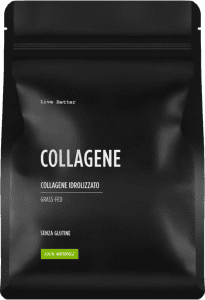
On our site you will find. collagen tasteless and odorless. It is grass-fed bovine collagen, meaning it comes from pasture-raised animals, so it is the most sustainable you can buy because ruminants make healthy, fertile soil. Because it is tasteless, you can add it to drinks, smoothies, yogurt, soups, omelets, or in the delicious kaiserschmarren Live Better with 46 g of protein!
Knowledge means freedom
Be Aware, Be Conscious, Live Better
BIBLIOGRAPHY
1) https://pmc.ncbi.nlm.nih.gov/articles/PMC6627940/
2) https://www.metabolismjournal.com/article/S0026-0495(25)00199-4/fulltext
3) https://pubmed.ncbi.nlm.nih.gov/23615880/
4) https://www.jbc.org/article/S0021-9258(19)55828-8/fulltext
5) https://pubmed.ncbi.nlm.nih.gov/17405135/
6) https://pmc.ncbi.nlm.nih.gov/articles/PMC4956528/
7) https://www.mdpi.com/2072-6643/15/6/1332
8) https://pubmed.ncbi.nlm.nih.gov/23107534/
9) https://pubmed.ncbi.nlm.nih.gov/23107545/
10) https://www.fao.org/4/i3124e/i3124e.pdf
11) https://pmc.ncbi.nlm.nih.gov/articles/PMC8912699/
12) https://pubmed.ncbi.nlm.nih.gov/21248165/

Leave A Comment