


























 EBOOK
EBOOK Insights
 Blog
Blog Tutorials
 GRASS FED
 PROFESSIONALS
 training
 LIVES
LIVES
PROTEIN SYNTHESIS: WHAT IT IS AND HOW IT WORKS
Premise: We still know very little about how the human body works. The knowledge we have today is not absolute certainty, only what has currently been discovered. Tomorrow it could change. Let's think about the scientific knowledge of 500 years ago and imagine what it might be in 500 years. We must recognize that we still know very little and therefore remain open and flexible.
Our bodies evolved over millions of years very differently from how we live today: we moved a lot, were often outdoors, and food wasn't always available. Therefore, we had good muscle mass, weren't overweight, and didn't live indoors in a box with artificial light. Technology has made our lives much easier, but today we are too sedentary. Up until 100 years ago, our lives were much more active: physically demanding jobs, doing laundry by hand, and walking a great deal. So today, our bodies are in a completely different condition compared to how they evolved over millions of years: sedentary lifestyle and excess nourishment. The result is there for all to see: metabolic diseases, being overweight, and frailty. Improving the situation is possible: eat food quantities that are adequate for our energy needs and move our bodies to maintain good muscle mass.
At the bottom of the page, you'll find a printable PDF and further in-depth information for experts, explaining the methods used to calculate protein synthesis (a bit technical). It also covers the main researchers in the field, the focus of their research, and a checklist for reading an article on muscle protein synthesis.
We would be VERY happy to know what you think of this in-depth analysis or if you have any questions, please comment below.
PROTEIN RENEWAL
The human body continuously renews all organs and tissues: some proteins are degraded (broken down) and then resynthesized (rebuilt).
Different tissues in the body have very different rates of renewal. The intestinal epithelium renews itself at a rate of 25–30% per day, so it is completely renewed every 3–4 days! Bone renews itself much more slowly: only 5–10% per year.
Proteins are made of amino acids, and the body uses:
amino acids obtained from the degradation of old proteins
– amino acids produced de novo by the body (defined as non-essential amino acids)
– amino acids introduced through diet (defined as essential amino acids)
According to current estimates, the body renews approximately 300g of protein each day. Most of the amino acids from protein breakdown are reused, but some are no longer usable and must be replaced by new amino acids obtained from the diet. If these are scarce, the body sacrifices skeletal muscle (1,2,3) because other organs and tissues, vital for our survival, absolutely need them. When this happens, muscle mass is lost.
PROTEIN SYNTHESIS
When we talk about protein synthesis, we think of muscle, but in reality, most of the protein synthesis that occurs daily involves other organs and tissues.
Fascinating: 30–40% of the amino acids obtained from the diet are retained by the liver and intestines (4). The rest enters the bloodstream, where it is pre-metabolized by organs, tissues, and muscles. Only 10–20% is utilized by the muscles. (5)
MUSCLE MASS AND LONGEVITY
Today, muscle is defined as the “organ of longevity”; the more muscle mass we have, the greater our chances of living a long and healthy life. (6)
Unfortunately, as the years go by, muscle mass is lost (sarcopenia) because:
The muscle is less sensitive to stimuli that trigger muscle synthesis (anabolic resistance).
2) increased protein degradation, due to age and exacerbated by:
– low-grade chronic inflammation
low-protein diet
3) Reduction of hormones that stimulate growth and tissue renewal: testosterone, estrogen, growth hormone, IGF-1. When they decrease, our body renews itself less and therefore ages.
Fortunately, it is possible to preserve muscle mass even as you age thanks to:
endurance training (dominant factor 85-90%)
adequate protein intake
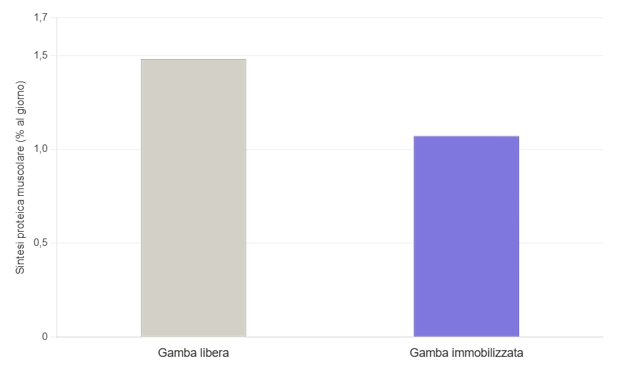
To illustrate the importance of movement, let’s look at the results of an interesting study involving 28 healthy young men who had a single leg placed in a cast for one week: during this brief period of immobilization, muscle protein synthesis decreased by 28% (7).
Imagine the effect on our bodies of decades of sedentary living...
MUSCLE MASS BENEFITS
Better blood sugar management, therefore better metabolic health (8)
Greater energy expenditure, therefore greater possibility of maintaining a healthy weight
Increased bone density, therefore reduced risk of fractures (9)
Increased chances of survival in cases of serious illnesses, for example, cancer (10)
Greater chance of returning to normal after a fracture over 65
Greater mobility, balance, and independence in later life
Muscle Protein Synthesis
When it comes to muscle protein synthesis, there are many false beliefs. Let's look at the current scientific evidence.
The world's most relevant researchers on muscle protein synthesis are:
Robert R. Wolfe, the father of the field
Stuart M. Phillips defined the specific rules of protein intake
Luc van Loon, the most pragmatic, created a bridge between the laboratory and real life.
Important: Initially, studies were conducted only with mixtures of essential amino acids, then with protein powders, and only recently with real food. This has made it possible to understand that real food is superior because it takes longer to digest and therefore provides amino acids for a longer period of time.
The following information refers to the normal, healthy population. Not professional athletes. Remember: these are not absolute and definitive truths, simply what has been discovered to date.
How much protein should I consume?
1.2 – 1.6 g per kg of body weight (ideal weight)
Donna, target weight 60 kg: 72 – 96 g protein
Man, ideal weight 80 kg: 96 – 128 g protein
For the average Italian population, these are the reference ideal weights based on average height: woman 165 cm, man 178 cm. Very often people overestimate their ideal weight and therefore overestimate their protein needs.
Increasing protein intake beyond 1.6 g per kg of body weight offers minimal benefits in general terms and particularly in increasing muscle mass (11). Higher protein intakes (up to 2g/kg) are only useful in particular conditions: malnourished elderly individuals, severe illnesses, post-traumatic recovery, and severely burned patients.
“Going beyond 1.6g won't give you bigger biceps, just more expensive pee” Stuart Phillips
Protein intake: are only noble proteins counted, or all of them?
All proteins should be included in the calculation of daily protein intake: animal, plant, high or low quality.
How many proteins in a single meal?
25-30 g of animal protein, which contain 2-2.5 g of leucine. Over 65 years of age: 3 g of leucine are necessary to activate protein synthesis. (12,13)
Plant proteins: being low in essential amino acids, it is necessary to increase the quantity and combine sources.
Is there a protein limit per meal?
It was once thought that 20 g maximized muscle protein synthesis, then a groundbreaking study by van Loon came out showing that the body can also utilize 100 g of protein in a single meal for muscle protein synthesis. (17) Furthermore, given what happens in some animals (snakes and crocodiles), it is hypothesized that this number could be higher, but to date, we still do not have scientific evidence regarding this.
Animal protein or plant protein: is there a difference?
Yes, there is a big difference: plant-based proteins do not contain essential amino acids in adequate amounts and are more difficult to digest. These problems can be overcome by increasing the quantity (and therefore calories) and combining sources (explained later).
A study conducted in the Netherlands on 16 healthy older adults found that a typical omnivorous meal based on animal protein stimulated muscle protein synthesis by approximately 47% more than a vegan meal, with the same protein and calorie content (18)

| Vegan egg white | Omnivorous diet |
| 200 g quinoa | 100 g lean beef |
| 95g of soy | 200g potatoes |
| 95 g of fava beans | 150 g of green beans |
| 95 g of chickpeas | 200 g of apple mousse |
| 15 g soy sauce | 24 g of herb butter |
Both meals contain 600 calories and 36g of protein each.
Interesting: plant-based protein powders (soy protein, pea protein, etc.) are more easily digestible than proteins in legumes and cereals, and therefore are as efficient as animal proteins for muscle protein synthesis (19).
Does intermittent fasting decrease protein synthesis?
No, if the correct amount of protein (1.2-1.6 g/kg) is assumed throughout the rest of the day, protein synthesis remains the same.
Should you consume protein immediately after a workout?
Myth now debunked: the anabolic window lasts 24-48 hours (20), with some suggesting even 72 hours (21). Therefore, there's no need to consume a shake immediately after training; it's sufficient to meet your protein intake throughout the day without stressing.
What stimulates muscle protein synthesis?
The anabolic stimuli (which initiate muscle protein synthesis) are two: the presence of 2-2.5 g of leucine in a meal and resistance training.
If 2.5 g of leucine are not consumed per meal, does protein synthesis not start?
Protein synthesis still occurs when the threshold of 2.5 g of leucine is not reached, but it is not optimal.
Do carbohydrates serve the purpose of muscle protein synthesis?
Another false myth: in studies on muscle protein synthesis, carbohydrates are never used because they are not necessary. Many years ago, it was thought they were needed because they raise insulin, which is necessary for the muscle synthesis process. In reality, proteins stimulate insulin to sufficient levels. (22) Carbohydrates are used to replenish muscle glycogen stores. If you are not an athlete who needs immediate replenishment, the food consumed throughout the day is enough to refill glycogen stores.
Do BCAA 2.1.1 also stimulate muscle synthesis after training, or only EAAs?
Both stimulate muscle synthesis, but the stimulation provided by BCAAs (branched-chain amino acids) is short-lived because they lack the other necessary amino acids (23). With EAAs (essential amino acids), the stimulation lasts longer because they also provide the other amino acids. Important: Free-form amino acids (BCAAs, EAAs) are digested and absorbed into the bloodstream very quickly. Their high availability over a short period of time means that not all of them can be used for protein synthesis, so some of the amino acids are oxidized (24). When you eat actual food, however, absorption into the bloodstream is slower, resulting in less oxidation.
Are protein powders or essential amino acids useful?
For most of the population, no, it's enough to meet your protein quota through food.
Essential amino acids and protein powders can be useful in specific contexts:
– during a significant caloric restriction
– for the elderly or hospitalized patients who do not consume sufficient quantities of protein
After 65 years, does the body use protein?
Beyond a certain age, muscles do not respond as they used to to stimuli that determine muscle protein synthesis (anabolic resistance). Resistance training and increased protein intake compensate for this phenomenon. If protein digestion is difficult, hydrolyzed protein powders or essential amino acid mixtures rich in leucine can be used. (25, 26, 27)
Is it okay to train on an empty stomach?
Yes, that's fine. Current evidence does not indicate differences in muscle mass growth. (28)
Does it make sense to take EAAs before going to sleep on rest days from training?
All researchers state that it is better to consume whole foods rather than protein powders or essential amino acids, and that it is sufficient to consume adequate protein intake over a 24-hour period.
Difference between collagen and whey, can they be combined?
Yes, they can be combined, but it doesn't provide benefits for muscle protein synthesis. Sometimes a study (29) by van Loon is cited where 5g of collagen and 25g of whey stimulate muscle protein synthesis. There's a problem, though: the control group takes nothing, only water. To demonstrate that collagen makes a difference, the control group should have taken only whey. Professor van Loon's group is currently studying how collagen supplementation affects the protein synthesis of collagen-rich tissues. Muscle is not rich in collagen.
When is too much protein too much? Is it bad for your kidneys?
If your kidneys are healthy, protein does not harm them; in fact, it's beneficial. We've dedicated an entire chapter to this topic to explain how this misconception originated.
What is the correct amino acid ratio?
The human daily requirement for essential amino acids as determined by the FAO in 2007 (30) is reported in the table below. ATTENTION: this is the minimum requirement to avoid deficiencies. As can be seen, a diet with animal proteins largely exceeds this minimum requirement. Today, the optimal requirement has not yet been determined. The proteins contained in food provide sufficient quantities, so essential amino acids or whey are not necessary.

Steak or ground meat?
Ground meat is digested better, and therefore more amino acids become available in the bloodstream. It's important to chew well. (31)
Does eating upright or lying down make a difference?
Eating right facilitates digestion and thus the amount of amino acids absorbed.
These last two considerations are important when there are bedridden patients, who may consume little protein.
Curiosity: cold water immersion immediately after training reduces muscle protein synthesis because it decreases blood flow to the muscle. Today, it is unknown what happens when immersing before, several hours after, or the day after training. (33)
PROTEIN DIGESTIBILITY
Proteins are very large molecules that are “cut” during the digestive process into individual amino acids, which can then be absorbed by the intestine.
Plant proteins are more difficult to digest because they are often “trapped” in cellular matrices and contain anti-nutrients (phytates, fiber, enzyme inhibitors). For this reason, their amino acids are less available for absorption.
% intestinal absorption (34):
animal protein 90-98%
plant-based proteins 70-90%
This data shows that our digestive system is optimized for digesting animal proteins, contrary to what is often said. It clearly adapts to vegetable ones as well, but it's less efficient.
PROTEIN QUALITY
The most modern method for evaluating protein quality is DIASS, which considers the essential amino acid content and digestibility of various protein sources (34).
Above 100 excellent quality, up to 75 good, below limited.
Milk powder 144
Bacon 142
Whey concentrate 133
Ribeye (costata) 130
Eggs 122
Beef Jerky 120
Soy flour 105
The only plant-based protein with a value above 100 is soy flour, because it's the only plant with a sufficient amount of essential amino acids. Complete list here. If you decide to consume soy, choose organic. Conventional soy is GMO and is grown using large quantities of glyphosate.
To compensate for the lack of certain essential amino acids, plant proteins need to be combined: legumes (deficient in methionine and cysteine) together with cereals (deficient in lysine). These are the traditional dishes of poor populations: rice and lentils, pasta and chickpeas, rice and peas, rice and beans.
The problem with these combinations is that they provide many more calories: to reach the protein and leucine content of 130g of chicken breast, you need to consume 95g of dry lentils along with 122g of rice. This combination provides 710 calories, compared to 130 calories for the chicken.
WHAT PROTEINS TO CONSUME?
The best proteins are animal-based because they contain essential amino acids in quantities and proportions suitable for human needs. They are also rich in leucine, which is necessary to stimulate optimal protein synthesis.
In this table are the grams of food (raw) that provide 2.5 g of leucine, ordered by increasing calories.. The protein and calorie content of the serving is also reported.
The only plant-based sources that provide adequate amounts of leucine are soy protein isolate and spirulina. All other plant-based sources need to be consumed in large quantities to provide 2.5 g of leucine (approximately 450 g of kidney beans or chickpeas).
Complete list here.

Do proteins damage kidneys?
This is a misconception that still persists. To understand its baselessness, let's analyze how it originated:
– Between the late 1800s and early 1900s, it was observed that in patients with kidney failure, diets rich in protein increased blood urea.
– In the 1950s, it was observed that proteins increased glomerular filtrate rate (GFR)
In the 1960s, the idea that proteins increase kidney workload became established.
In the 80s, Barry Brenner formulated a hypothesis: hyperfiltration (an increase in “normal” GFR) damages the glomeruli. It's just an intuitive idea not supported by evidence, a bit like Ancel Keys’ “lipid hypothesis” on saturated fats and cardiovascular disease.
– in the 90s the idea had become widespread: a diet rich in protein could “consume” the kidney
– in the 90s, the results of the first studies began to emerge, showing that proteins actually do not decrease kidney function. The hypothesis began to falter
– in 2005, American guidelines definitively debunked the hypothesis, as evidence showed that in reality, a lower protein intake decreases kidney function (35)
What is the strongest scientific evidence today:
– GFR increases with higher protein intake, but this is not an issue, it is a normal physiological adaptation (36)
– proteins are not the cause of the decline in GFR observed with advancing age (37)
– higher protein intake is associated with a reduced risk of developing chronic kidney disease (38)
Forty years ago, it was thought that an increase in glomerular filtrate (GFR) due to higher protein intake could damage the kidneys. Today, however, it is considered a normal physiological adaptation that increases the capacity to eliminate urea, creatinine, metabolites, and toxins.
Clearly, this discussion is only valid for healthy kidneys; when kidneys are diseased, they cannot do their job. In diseased kidneys, the ability to eliminate nitrogen is reduced, so protein intake is often modulated to avoid urea accumulation.
So why are there still doctors who think protein damages kidneys? Because scientific misconceptions take decades to correct. The physicist Max Planck said, “A new scientific truth does not triumph by convincing its opponents, but rather because its opponents eventually die, and a new generation grows up that is familiar with it.”
Do proteins damage the liver?
Regarding the liver, the story is similar:
– the liver is where amino acids not used for protein synthesis are “broken down” and the nitrogen they contain is converted into urea
– from this mechanism the idea was born: more protein, more work for the liver
- In diseased livers (cirrhosis and liver failure), the liver is unable to properly manage urea
– in this case too, a characteristic of the diseased liver was extended to healthy subjects
Today we know that a healthy liver has no problem processing urea, and that diets with adequate protein intake do not harm the liver; quite the opposite! (39) The liver retains many of the amino acids we consume in food because it needs them to produce various molecules, including albumin, enzymes, and hormones.
Are nitrogenous waste products harmful?
Nitrogenous catabolites are the waste products derived from the metabolism of amino acids and other nitrogen-containing molecules in the body. They are called “nitrogenous” because they contain nitrogen.
The main nitrogenous catabolites are:
Urea, 80-90%, is derived from deaminated amino acids (from which nitrogen has been removed) in the liver (40)
ammonium, 5-10%, produced in the kidney from glutamine, extremely useful for balancing pH
Creatinine, 2-5%, is derived from muscle creatine and is largely unaffected by diet
Uric acid, 1-2%, is derived from purines (nitrogenous bases in DNA and RNA, ATP, and coenzymes)
The main nitrogenous catabolite is urea, which mainly derives from daily protein turnover. Urea is a very normal thing, the simple consequence of the protein turnover necessary to maintain a healthy body. IMPORTANT: urea is not a “waste product” in the strict sense, but the inevitable nitrogen surplus from protein metabolism.
How much urea can the body handle
There is no maximum protein intake limit in the guidelines (41).
However, we know that the urea cycle is limited and depends on body weight. Taking this limitation into account, the maximum estimated protein intake today is: (42)
Weight 60 kg = 210 – 258 g protein (3.5 – 4.3 g/kg)
80 kg weight = 285 – 365 g protein (3.5 – 4.6 g/kg)
Despite these numbers, researchers today believe that the absolutely safe limit is: 3.5g of protein per kg of body weight.
Knowledge makes one free!
Be informed, be aware, live better
BIBLIOGRAPHY
1) https://pubmed.ncbi.nlm.nih.gov/4915800/
2) https://pubmed.ncbi.nlm.nih.gov/5773094/
3) https://pubmed.ncbi.nlm.nih.gov/7783655/
4) https://pubmed.ncbi.nlm.nih.gov/11773519/
5) https://pubmed.ncbi.nlm.nih.gov/26556791/
6) https://pubmed.ncbi.nlm.nih.gov/24561114/
7) https://pubmed.ncbi.nlm.nih.gov/37994085/
8) https://pubmed.ncbi.nlm.nih.gov/16960159/
9) https://pubmed.ncbi.nlm.nih.gov/9333113/
10) https://pubmed.ncbi.nlm.nih.gov/10865809/
11) https://pubmed.ncbi.nlm.nih.gov/28698222/
12) https://pubmed.ncbi.nlm.nih.gov/16507602/
13) https://pubmed.ncbi.nlm.nih.gov/25056502/
14) https://pubmed.ncbi.nlm.nih.gov/30659499/
15) https://www.gssiweb.org/docs/default-source/sse-docs/vanloon_sse220.pdf?sfvrsn=2
16) https://pubmed.ncbi.nlm.nih.gov/30167963/
17) https://pubmed.ncbi.nlm.nih.gov/38118410/
18) https://pubmed.ncbi.nlm.nih.gov/37972895/
19) https://pubmed.ncbi.nlm.nih.gov/38228945/
20) https://pubmed.ncbi.nlm.nih.gov/38716482/
21) https://pubmed.ncbi.nlm.nih.gov/16002437/
22) https://pubmed.ncbi.nlm.nih.gov/18577697/
23) https://pubmed.ncbi.nlm.nih.gov/31250889/
24) https://pubmed.ncbi.nlm.nih.gov/11158939/
25) https://pubmed.ncbi.nlm.nih.gov/25923479/
26) https://pubmed.ncbi.nlm.nih.gov/40288581/
27) https://pubmed.ncbi.nlm.nih.gov/41963141/
28) https://pubmed.ncbi.nlm.nih.gov/41316673/
29) https://pubmed.ncbi.nlm.nih.gov/39501478/
30) Protein and amino acid requirements in human nutrition, FAO
31) https://pubmed.ncbi.nlm.nih.gov/23636241/
32) https://pubmed.ncbi.nlm.nih.gov/27089362/
33) https://pubmed.ncbi.nlm.nih.gov/31788800/
34) https://www.fao.org/ag/humannutrition/35978-02317b979a686a57aa4593304ffc17f06.pdf
35) https://www.nationalacademies.org/read/10490/chapter/13#841)
36) https://pubmed.ncbi.nlm.nih.gov/30383278/
37) https://pubmed.ncbi.nlm.nih.gov/41894612/
38) https://pubmed.ncbi.nlm.nih.gov/38946781/
39) https://pubmed.ncbi.nlm.nih.gov/27807480/
40) Guyton & Hall, Textbook of Medical Physiology
41) https://sinu.it/wp-content/uploads/2025/07/Tabelle-riassuntive_online.pdf
42) https://pubmed.ncbi.nlm.nih.gov/16779921/




Thank you for these in-depth articles, invaluable information.
I'm 67 years old and decided to move to the countryside 4 years ago. I take your collagen twice a day and eat at least 4 eggs a day from my happy, free-range chickens.
Vegetables and fruit strictly from my garden, and I only see the doctor once a year for routine checkups...
Thank you Elena and your colleagues for the always valuable content you give us
I wish you all the best and serenity.
Excuse me, but in the summary, I didn't fully understand how many protein grams per kilogram of body weight I should consume. I only eat meat, fish, fats, and zucchini (very few). I consume about 300 grams of protein between lunch and dinner, raw weight. I weigh 57 kg. My nutritionist gave me this amount. I am 65 years old and do not exercise because I have a disabled 91-year-old mother and I don't have the time or desire to exercise because I'm already exhausted like this. Thank you if you can answer. Regards, Irina.
Hi Irina,
between 1.2 and 1.6 g per kg of body weight, taking into account ideal weight, so in your case between 68 and 83 g of protein. 300 g of protein between lunch and dinner recommended by your nutritionist, I imagine refers to the raw weight of the protein, correct? 100 g of meat contains about 22/24 g of protein, so 300 g provides 60/66 g of protein. Fish contains less than 20 g of protein per 100 g, eggs only 12 g per 100. Here you can find a list with the protein content in 100 g of various foods. https://www.livebetter.eu/proteine-fondamentali-per-la-nostra-salute/
Well-done article, congratulations
Great job!!!
I find this in-depth analysis very useful; it's simple to read, exhaustive, and understandable to everyone. Congratulations, the information you provide, although partly already known, has convinced me that the diet I am following (always encouraged by your advice) aims for healthy longevity.
Truly, you've done a great job. Congratulations. I'll read it, study it, and share it.
Excellent work.
I don't fully understand if a liver with cirrhosis should therefore eat little meat?
Hi Enrica,
No, with liver cirrhosis, you should not eat less meat: this is an outdated idea! The current ESPEN guidelines (also adopted in Italy) recommend a protein intake of 1.2–1.5 g per kg of body weight per day, with no distinction between animal and plant sources and without excluding meat. Proteins should not be reduced even in the presence of hepatic encephalopathy! In cases of advanced cirrhosis, BCAA supplementation has proven useful, also for preventing sarcopenia.
Here is the link to the guidelines in the Italian translated version:
https://www.sinpe.org/documenti/LG%20ESPEN-SINPE%20Nutrizione%20Clinica%20nelle%20Malattie%20di%20Fegato.pdf
Truly well-done and interesting in-depth article! You once again prove how serious you are in your work. Excellent point about not needing amino acid supplementation when the diet is omnivorous and adequate. Instead, they need to be considered when dealing with vegetarians and vegans. The discussion there is very different, and you explain it well. The emphasis you place on leucine is also an essential point that is often overlooked. I agree with exercising on an empty stomach (especially in the morning after a good 14-16 hour intermittent fast) to deplete glycogen stores and make metabolism work its best!
Thank you and well done!
Clear, simple, precise, and complete. It's nice to know one has the tools to do well for oneself, thank you for the immense work!
Ever more complete! Thank you Laura and thank you Elena
Thank you. You are fantastic!
Extremely interesting in-depth analysis. Clear and simple, thank you thank you
The article is well-written, understandable for everyone, and very comprehensive. Congratulations indeed. I like "live Better" because it's a serious company, and it's not easy to find one nowadays that doesn't just want to do business. Thank you.
Very interesting, complete, and thorough as always. Thank you
Thank you very much Elena for this interesting insight. It clarifies some aspects that are often confusing and provides concrete, easy-to-use suggestions (see table of foods with 2.5 g of leucine).
The article is truly very interesting, clear, and comprehensive. Great job!
Thank you very much for the welcome insights!!
Great article, you are as brilliant as always.
I've read all the in-depth articles, and I have to say this last one is very interesting. Thank you for the simple way you write; it's accessible to everyone.
Thank you, you've opened up a world for me
Thank you Elena for this serious research work that you make available.
A thousand thanks Elena for all the study and outreach work, I believe you are a great help to many people, well done!!
Good morning, I am 148 cm tall. What is my ideal weight? How many grams of protein per day?
Thank you and congratulations on the very interesting and in-depth article.
Hi Anna,
For a height of 148 cm, considering a BMI between 18.5 and 24.9, the ideal weight ranges from
minimum: approximately 40 kg
maximum: about 54 kg
Clearly, it also depends on muscle mass because with a BMI of 24.9 and a lot of muscle mass, you'd look lean, while with a BMI of 24.9 and little muscle mass, you'd look soft.
Thank you
Elena
Thank you for the truly interesting information, I have a few questions to ask:
What is meant by ideal weight? The current weight or the one you want to reach?
I am underweight (very underweight), 50 years old, 56kg x 174cm, with light activity every morning for 30/40 minutes and weight training 3 times a week. In my case, does it make sense to increase the protein intake beyond 1.6g per kg of body weight? Or does the same rule apply as for people of normal weight?
Thank you for your time.
Hi Riccardo,
One must take into account ideal weight, meaning the optimal weight.
For a height of 174 cm, a BMI between 18.5 and 24.9 would have a healthy weight range of:
Minimum: approx. 56 kg
maximum: about 75 kg
Clearly, a lot also depends on a person's muscle mass.
If you wanted to weigh 64 kg, use that number to calculate protein intake. In your case too, 1.2-1.6 g/kg is recommended
Thank you
Elena
Thank you so much, you are very kind.
I have the opposite problem of many people; it's difficult for me to stay under 2g/kg of body weight for protein. I'll try to lower it a little and raise fats and carbohydrates a bit. Let's see if I can make my pee less expensive...
Hi Riccardo,
2 g/kg won't hurt you. So you can continue to eat them without worry if they agree with you.
Thank you very much, very interesting
As always, the in-depth analysis is very interesting.
Now it's all much clearer...
Since I'm in menopause, even though I eat a 200g portion of meat or fish per meal, I used to “stuff myself” with MAP, thinking I was making a good protein “stockpile”... to produce expensive pee😂😂😂
Thank you so much for the work you do for us!
Hello Elena, thank you as always for this very useful information. I perceive you as a very serious and knowledgeable person, and I always read you with great interest. I am also a big fan of your products. I'd like to take this opportunity to ask for your advice: I am 1.70 meters tall and weigh 55 kg. I am in menopause, I am 53 years old, and I do a light jog every morning for 20-30 minutes. I also do high-intensity strength training three times a week. How many grams of protein should I consume per meal to increase muscle mass? Thank you very much.
Hello Fatima,
Considering that it's not necessary to go beyond 1.6g of protein per kg of body weight per day, it's important for you not to go below 90g of protein per day, so 30g per meal if you have 3 meals. It's better if these proteins are of animal origin, as this will ensure you have a sufficient level of leucine to optimize muscle protein synthesis. To increase muscle mass, you could incorporate more resistance exercises. Try asking your Personal Trainer.
Thank you
Thank you for the valuable guidance..💚
Thank you for the work done, I know how challenging it is. The in-depth analysis has provided an updated and clear view of the issue.
Hi Elena, thanks for the in-depth explanation, it was very nice and interesting.
I wanted to know if we should take 2.5g of leucine with every meal for protein synthesis?
Thank you very much
Hello Romina
if you want to optimize muscle protein synthesis, yes.
If you don't reach them, it still happens but less.