
























 EBOOK
EBOOK Insights
 Blog
Blog Tutorials
 GRASS FED
 PROFESSIONALS
 training
 LIVES
LIVES
THE TRUTH ABOUT PALM OIL
A few years ago, palm oil was unfairly condemned. There were two reasons: environmental and healthful. Let's go and analyze them.
ENVIRONMENT
Forests are being cleared to grow palm oil. True, undeniable. But beware: any human activity has an impact on the environment. What we should do is look for the most sustainable solutions that exist.
Let us then look at the yield per hectare (1) of various crops for vegetable oil production:
Palm 2.99 tons per hectare
Canola 0.73 tons per hectare
Sunflower 0.63 tons per hectare
Soybean 0.47 tons per hectare
Olive 0.32 tons per hectare
Coconut 0.24 tons per hectare
So palm oil cultivation has 4 times the yield of rapeseed oil, which ranks second in yield per hectare. What does this mean? If we were to replace palm oil production with rapeseed oil we would need to use 4 times the land used for palm oil. So we would have to deforest much much more.
Worldwide, most vegetable oil production (2) comes from palm oil, but in second place is soybean, which, however, ranks only fourth in yield per hectare. If we were to produce the amount of palm oil from soybeans, we would need 6 times as much land today for co lation of palm oil!
And here the first question arises for me: how come soybean ranks second in world vegetable oil production? Why is rapeseed, which has a 50% higher yield than soybeans, not used? The only answer I can come up with is: economic interests. Between 2018-2020, Corteva (formerly DuPont) and Bayer (through Monsanto) controlled 65.9% of the U.S. soybean market (3).
Now I would like to make a moral point: on our planet, the areas that are left to be deforested are in developing countries. Our Europe was covered with forests in the year 1000, but then we cut it all down in order to have fields to cultivate and wood to build and heat. So I wonder, why should we now prevent developing countries from doing what we did in the past?
To me it always looks like the usual colonial arrogance....
Another important observation is that trees to produce palm oil are perennial, last 30 years, and are 20 meters tall. So growing palm trees to produce oil sequesters much more carbon dioxide than the 20-cm soybean seedlings that need to be planted every year.
Other key aspect to mention, the use of pesticides (4)
Palm 2 kg/t
Soybean 29 kg/t
I am sure that at this point there will be no doubt that palm oil cultivation is the most environmentally sustainable.
HEALTH
Now let us turn to the health reasons and analyze them:
- Contains lots of saturated fat
- Contains monochloropropanediol
For the past 50 years, saturated fat has been unfairly condemned as the cause of cardiovascular disease. But in reality, the “Diet Heart Hypothesis” has never been scientifically proven and remains only a hypothesis to this day. I recommend that English speakers read the book The Big Fat Surprise by investigative journalist Nina Teicholtz.
There have been two major randomized controlled trials, the Minnesota Coronaty Experiment (5) and the Sidney Heart Study (6), that have largely disproved the “Diet Heart Hypothesis.” In these two studies with a very high level of scientific evidence, it was found that replacing saturated fat with unsaturated fat increased mortality! These studies were not published by the researchers who conducted them because the results were contrary to what they expected, that is, they did not confirm the “Diet Heart Hypothesis.” This anti-scientific attitude has caused the guidelines of the last fifty years to advise people to replace saturated fats with unsaturated fats (seed oils).
Seed oils are very rich in linoleic acid, omega 6. Consumption of these vegetable oils has raised the omega 6:omega 3 ratio to alarming values: 20:1 when it should be 4:1. This excess of linoleic acid is now believed to be a major cause of the most common modern diseases: cardiovascular disease, cancer, and obesity (7).
The truth is that saturated fats are MUCH more stable than unsaturated fats and therefore do not oxidize easily. The products of fat oxidation are toxic and carcinogenic.
Reflection: our body produces only saturated fat. How is it possible for the body to create types of fat that harm it?
Monochloropropanediol
Monochloropropanediol is a molecule that develops in all fats when high temperatures are reached. In palm oil it is formed in higher amounts than in other fats. In 2016, EFSA published its opinion on the intake of this substance (8) putting fairly low limits on its consumption. Two years later, however, it published a review, “Consumption levels of 3-MCPD via food are considered risk-free for most consumers, but there is a potential health concern for heavy consumers in younger age groups. In a worst-case scenario, infants fed exclusively on formula might slightly exceed the safe level.” And here again I wonder: why is it permissible to use ingredients that contain potentially dangerous substances for infants? One day Live Better will also produce infant formula. That is a promise.
However, two years after publishing the safety levels regarding monochloropropanediol, EFSA increased them by two and a half times (9): 2.0 micrograms per kg of body mass. I would like to point out that the safety levels published by FAO-WHO are twice as high: 4.0 micrograms per kg of body mass.
In addition, it is important to know that the industry has improved production processes, this has made it possible to halve the content of monochloropropanediol in palm oil (10). Solutions always exist, you just have to look for them.
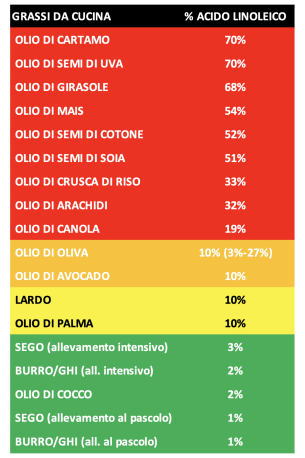
Today we know that excess linoleic acid in our diet is deleterious (7). Palm oil contains very little of it compared to seed oils, so it is the best solution in this respect as well.
A personal reflection at this point: one program that contributed a great deal to the denigration of palm oil was Report. When Report did a story on photovoltaics, which was the industry where I worked and therefore knew perfectly well, I realized how they manipulated information to create false negative perceptions. I wondered, if they did it with PV they probably do it all the time, but me not knowing in depth the topics they cover, I didn't realize it. When the report on palm oil came out I had further confirmation, and from then on I never watched Report again.
Special mention: when the palm oil case broke out in Italy, all companies replaced it in their recipes with other fats. All except one: Ferrero. Ferrero was the only company that had the courage to stand by its choices. They argued them, buying advertising space to explain their reasons. I always loved Ferrero, because Mr. Michele Ferrero was a genius and created products of the highest level, but with that choice my esteem for the company grew exponentially. Unfortunately, today without Mr. Michele Ferrero, the company is not the same. Before anyone says, “Elena but how can you say they are top-notch products!!!?” I invite you to look at the ingredients of the products created by Mr. Michele: there is nothing strange, only natural products. Sure they are full of sugar, but Mr. Michele was an entrepreneur in a time (the postwar period) where sugar was viewed positively i

n how much it contributed calories.
Look at the 1951 Ferrero Supercrema (later called Nutella) advertisement: in a society malnourished after five years of war, the highlight of Supercrema was having 5,100 calories! Modern society is overweight, so this reasoning sounds strange, however, it is always necessary to put things in historical context: back then, Supercrema was an extraordinary product to bring in extra calories. Mr. Michele's products are manufacturing masterpieces: think Ferrero Rocher, Mon Cheri or Estathé. Probably very few people know this, but Estathé was the world's first iced tea from infusion of real tea leaves! Mr. Michele invented the process in 1972, and since then Estathé has been the undisputed leader of iced tea in Italy.
Well, I hope this insight may have been helpful to you in understanding how the things we are told are not always the truth.
Live Better will always strive to provide rigorous and truthful information, even if sometimes finding the truth seems like a titanic task. When we have the Live Better Foundation, however, it will be easier: we will go after the truth ourselves.
Knowledge makes one free.
Elena
BIBLIOGRAPHY
- https://ourworldindata.org/grapher/oil-yield-by-crop
- https://ourworldindata.org/grapher/vegetable-oil-production
- https://www.seedworld.com/us/2023/10/04/usda-details-market-shares-of-biggest-seed-industry-players/
- https://www.asianagri.com/en/media-publications/articles/the-benefits-of-palm-oil/
- https://www.bmj.com/content/353/bmj.i1246.long
- https://www.bmj.com/content/346/bmj.e8707.long
- Chris Knobbe, The Ancestral Diet Revolution
- https://www.efsa.europa.eu/en/efsajournal/pub/4426
- https://www.efsa.europa.eu/it/press/news/180110
- https://www.alfalaval.com/products/process-solutions/edible-oil-solutions/edible-oil-refining-process-systems/how-to-reduce-3mcpd-and-ge-palm-oil-contaminants-during-palm-oil-processing/#:~:text=Starting%20January%201%2C%202022%2C%20the,integrated%20refineries%2C%20exporters%20and%20importers




Leave A Comment